Focusing Acoustic Energy, Redefining Non-invasive Ablation.
Non-invasive Ultrasound Histotripsy — A novel non-invasive, non-thermal, and non-ionizing ablation technology for liver tumors.
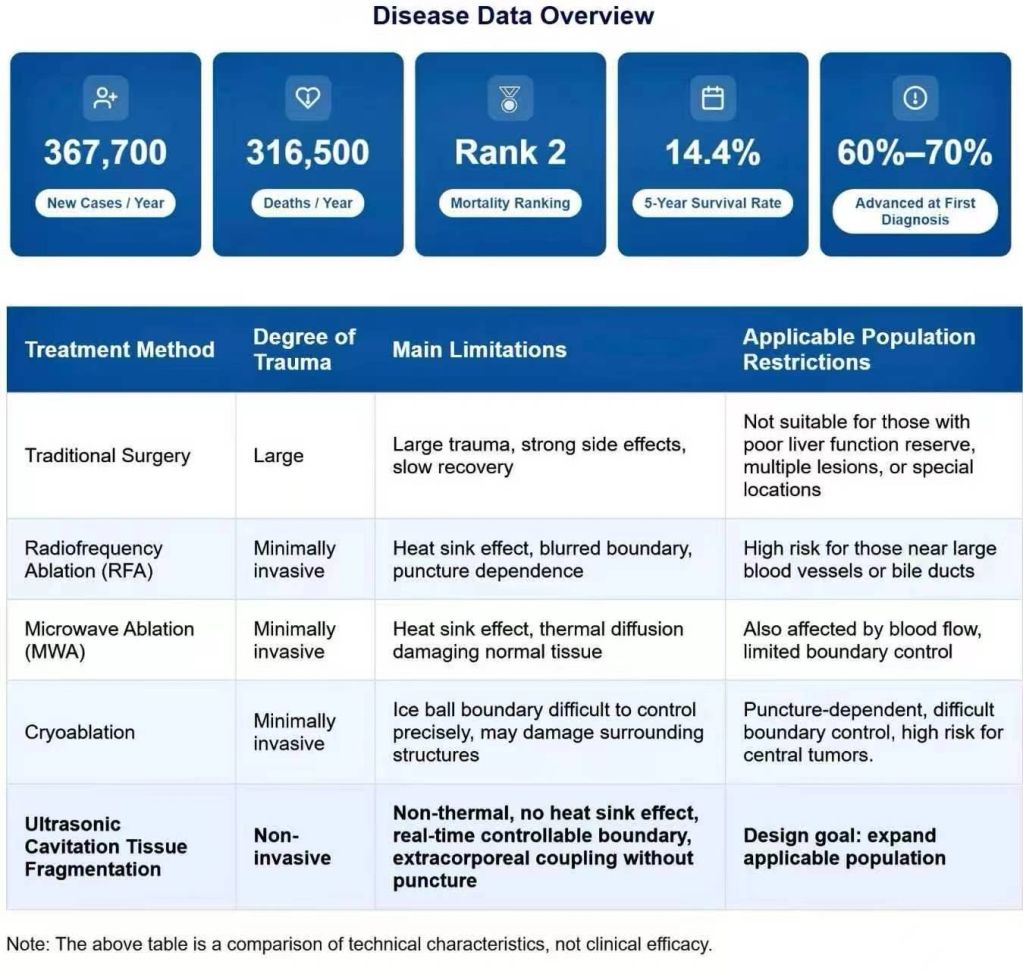
Current Disease Landscape and Comparative Data
Traditional surgical treatments have large trauma, strong side effects, and slow recovery. Ablation techniques such as radiofrequency ablation (RFA), microwave ablation, and cryoablation are limited by the heat sink effect, blurred margins, and puncture dependence.
Therefore, there is a clinical need for a novel non-thermal, non-invasive ablation technology with real-time controllable boundaries.
Breaking Physical Limits of Traditional Ablation
Say Goodbye to Heat Sink Effects, Say Goodbye to Puncture Paths.
Non-invasive Ultrasound Histotripsy — Precise extracorporeal focusing for non-invasive, non-thermal tissue fragmentation.
Not by Heat, But by Mechanical Force.
Non-invasive Ultrasound Histotripsy utilizes short pulses and high peak-focused ultrasound to generate controllable cavitation clouds within the target tissue.
During the processes of nucleation, expansion, contraction, and violent collapse, the cavitation bubbles release shock waves and high-speed microjets of up to hundreds of megapascals. Through mechanical forces, they disrupt tumor cell membranes and subcellular structures, physically fragmenting the tumor tissue into acellular fragments.
The entire process does not rely on temperature elevation, thus there is no heat sink effect, clearer boundaries can be achieved, and the impact on surrounding normal tissues is more controllable.
Non-thermal mechanism: Tissue destruction is dominated by cavitation mechanical forces. It is effective even in large blood vessels nearby, and is not affected by the heat sink effect.
Non-invasive operation: The treatment head is coupled extracorporeally, requiring no transdermal puncture.
Real-time visualization of boundaries: The cavitation cloud is visible under real-time ultrasound, allowing for precise confirmation of the ablation zone during treatment.
Tissue fragmentation: The target tissue is mechanically fragmented into acellular fragments, presenting a homogeneous liquid consistency, which is subsequently absorbed by the body.
Nucleation → Bubble Formation → Inertial Growth → Violent Collapse → Bubble Cloud

Extracorporeal Focusing, Intracorporeal Ablation
Ultrasound energy penetrates the skin and tissues. At the focal point, it triggers cavitation and generates a cavitation cloud. By precisely controlling the focal position and energy distribution, it achieves coverage of the planned target area.

Why Non-Invasive Ultrasound?
For Patients: Expanding the boundaries of non-invasive treatment.
For patients with poor cardiopulmonary function, or tumors adjacent to important blood vessels/bile ducts, non-invasive ultrasound provides a completely non-invasive treatment option with no surgical incisions, helping to reduce surgical trauma and complication risks.
For Surgeons: Breaking physical limits.
Traditional thermal ablation (such as RFA, MWA) is affected by the heat sink effect, and cryoablation is limited by the ice ball boundary. Non-invasive ultrasound achieves real-time imaging guidance under ultrasound, generating a cavitation cloud at the focal point to destroy the target area with mechanical force. This non-thermal mechanism, along with its relative preservation of critical structures (such as blood vessels), provides a new treatment strategy for complex cases that are difficult to treat with thermal ablation.
For Healthcare Systems: Optimizing processes and resources.
Eliminates the need to establish a sterile puncture tract. The purely extracorporeal operation mode simplifies the surgical procedure and simultaneously provides an engineering foundation for shorter treatment cycles and future outpatient models.
R&D TEAM
Intersection of Medicine & Engineering, Deep Integration of Industry, Academia, Research & Medicine.
The team integrates clinical medical insights with acoustic engineering technology. We have jointly established industry-academia-research laboratories with universities, covering a complete closed-loop of medical device R&D from underlying physical mechanism research and core key material breakthroughs, to system prototype development, and then to a rigorous compliance registration pathway, ensuring that the technology can be safely and reliably translated into clinical applications from concept.
We believe
Non-invasive is the next step for minimally invasive treatment.
We chose non-invasive ultrasound because it mechanically breaks free from the dependence on thermodynamics or extreme low temperatures, relying solely on acoustic focusing to achieve precise tissue destruction.
The starting point of technology is the feature; the endpoint is patient benefit.
Non-thermal, non-invasive, real-time controllable boundaries, and tissue selectivity—these are not only technical parameters, but also the underlying logic we follow in R&D: How to maximize the preservation of normal tissues and physiological functions while destroying lesions.
From the lab to the clinic.
As an emerging technology, we are well aware that bringing it to the clinic requires rigorous evidence and long-term validation. We are steadily advancing regulatory registration and clinical research, looking forward to providing a new option for more patients waiting for new solutions.
Contact Us
Please contact us directly with any questions, comments, or inquiries you may have.
NIU Histotripsy
Email: info@jkhhealth.com Hotline Service: +86-755-27926585
Subscribe
Sign up to hear from us.
Copyright © 2026 NIU Histotripsy - All rights reserved.
Note: The non-invasive ultrasound tissue fragmentation system is currently in the research and development and registration stages and has not yet obtained marketing approval in any country or region. The technical information contained on this website is intended solely for scientific exchange and academic discussion and does not constitute any medical advice or product promotion.